








Will You Get Your Money Back? The Truth About Repairing a Semi-Truck Before You Sell
If you're thinking about selling your semi truck, one question can save or cost you thousands of dollars: Should you repair it first? The answer isn't always obvious. Some repairs increase resale value, while others rarely pay for themselves. This guide explains which fixes usually make financial sense, which ones don't, and how experienced truck buyers evaluate used semis so you can make the smartest business decision before spending another dollar.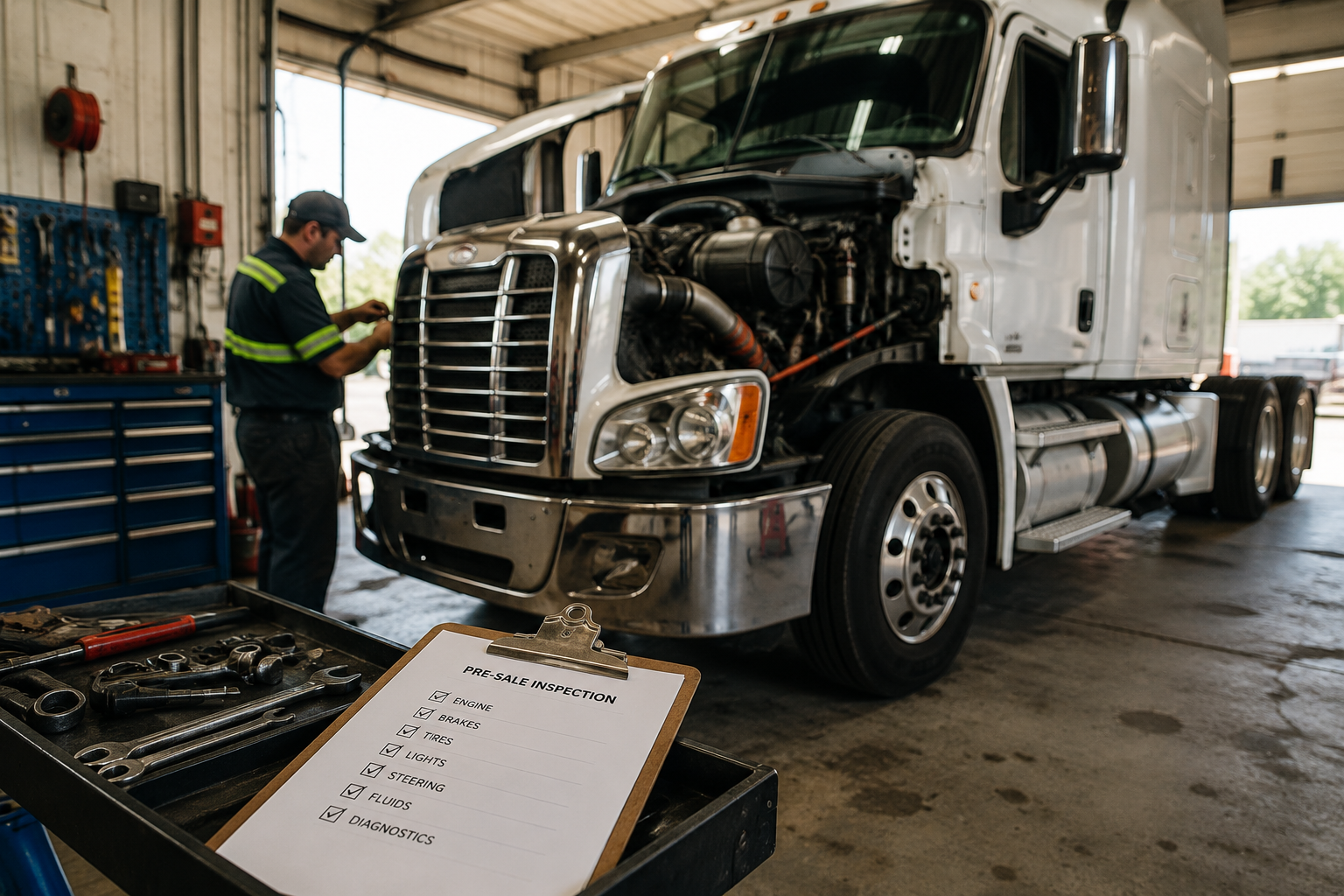

Quick Guide: Before You Spend Money Repairing a Semi Truck to Sell
- Treat every repair like an investment. Ask whether you'll recover the cost at resale, not simply whether the truck "needs" the repair.
- Fix safety issues first. Good brakes, quality tires, working lights, and proper steering reassure buyers and remove major obstacles to a sale.
- Make sure the truck runs and drives properly. A truck that starts, shifts, and can be inspected is worth considerably more than one that can't.
- Eliminate diagnostic uncertainty. Active fault codes, warning lights, and unreadable gauges create doubt that usually lowers offers.
- Consider the truck's overall value before approving expensive repairs. A $3,000 repair makes far more sense on a $40,000 truck than on one worth $12,000.
- Remember that local demand affects value. A sleeper in Texas or Georgia may justify repairs that wouldn't make financial sense in another market.
- Think carefully before major engine or emissions work. Large repair bills often add only a fraction of their cost to the truck's resale value.
- Keep every maintenance record you have. Organized service documentation builds buyer confidence and often increases value without spending additional money.
- Clean the truck, but don't overspend on cosmetics. Buyers care much more about mechanical condition than expensive paint or chrome.
- Be honest about the truck's condition. Experienced buyers usually trust transparent sellers more than trucks presented as "like new."
- Get an offer before authorizing costly repairs. A professional truck buyer can often tell you whether the repair is likely to increase your final selling price.
What Repairs Actually Increase a Semi Truck's Resale Value?
You are standing in the shop bay. The mechanic hands you an estimate for $5,000, maybe more. The truck runs, mostly. But you have already decided you are probably going to sell it. Now the real question hits you: if you spend that money before you sell your semi truck, will you actually get it back?
It is a fair question, and it is a business question. A lot of owner-operators assume the answer is automatic. Fix the truck, add value, sell it for more. Sometimes that is exactly how it works. Just as often, it is not.
Here is the truth that experienced sellers learn, sometimes the hard way. Not every repair increases a truck's resale value. Some repairs pay you back and then some. Others cost you thousands and return only pennies on the dollar. The smartest move before selling is rarely to fix everything. It is to understand which repairs buyers actually value and which ones simply drain your profit.
Kelly Truck Buyers has evaluated thousands of trucks bought directly from owner-operators, small fleets, and transportation companies across the country. Every truck gets looked at on its own terms, its own age, mileage, condition, and the demand for that specific configuration. Because Kelly buys trucks in nearly any condition, the company has no reason to push sellers toward repairs they do not need. In many cases, Kelly will tell a seller plainly when a repair is worth making and, just as often, when it is not. The goal of this article is the same: to help you think like a business owner before you spend a dollar.
Every Repair Is an Investment, Not an Expense
The first shift is a mental one. Stop asking, "Does this need fixing?" Almost anything on a used semi-truck can be fixed. Start asking a sharper question: "If I spend this money, how much of it comes back when I sell?"
That reframes a repair as an investment with a return, not just a bill to pay. Some investments return more than their cost. Some return most of it. Some return almost nothing. A truck you are about to sell is not a truck you are keeping on the road for another 300,000 miles, so the math is different. You are no longer buying reliability for yourself. You are buying resale value, and only some repairs actually deliver it.
Repairs That Usually Pay Off
Certain repairs tend to earn their money back because they remove risk, unlock a sale, or make the truck easier for a buyer to trust. These are usually worth doing.
Safety-Related Issues
Brakes, tires, steering, and lights sit at the top of this list. A buyer, especially a professional one, sees a safety defect as both a cost and a red flag. Worn brakes or bald tires do not just lower the offer by the cost of the parts. They make a buyer wonder what else was neglected.
Brake work commonly runs $800 to $1,500 per axle, and a full set of drive and steer tires often falls in the $3,000 to $6,000 range depending on quality. These are not glamorous repairs, but they clear the biggest doubts a buyer has, and they tend to hold their value at resale better than almost anything else.
Operational Problems That Keep the Truck From Working
If a truck will not pass a basic inspection, throws a hard fault, or sits in limp mode, that problem is not just lowering your price. It may be blocking the sale entirely. A truck that cannot demonstrate that it runs and drives is worth far less than one that starts, moves, and shifts cleanly.
Repairs that restore basic operation, an air leak, a dead sensor, a failed regen, a no-start condition, usually pay for themselves simply by moving the truck from "project" to "running unit." Buyers pay a real premium for a truck they can drive onto a trailer under its own power.
Repairs That Make the Truck Easy to Inspect
There is a quiet category of repairs that pays off for a reason many sellers miss. Anything that lets a buyer verify the truck's condition adds value. A working dash, readable gauges, no active fault codes, and a clean diagnostic scan all let a buyer confirm what they are getting. Uncertainty always costs the seller money. When a buyer cannot verify something, they assume the worst and price for it.
Repairs That Depend on the Truck
This is the gray zone, where the right answer changes based on the truck's age, mileage, overall condition, and the demand for that specific model. The same repair can be smart on one truck and a waste on another. A 2018 sleeper worth $42,000 may justify a $2,500 repair. A 2012 truck worth $15,000 probably doesn't.
Consider a moderate repair in the $2,000 to $4,000 range on a truck worth $30,000 versus the same repair on a truck worth $12,000. On the higher-value truck, that fix might be the difference between a clean sale and a discounted one. On the lower-value truck, you could spend a third of the truck's value chasing a return that will never fully materialize.
Regional demand matters here too, and it can swing the math. A well-spec'd sleeper in strong freight lanes through Texas or Georgia may justify repairs that the same truck would not justify elsewhere, simply because more buyers are competing for it. Day cabs set up for regional and port work move quickly in Florida. Across the Midwest freight belt of Illinois and Indiana, high-mileage highway trucks are common inventory, so buyers there are less willing to pay a premium for cosmetic freshness. In Michigan and other cold-weather markets, a truck with documented cooling, heating, and starting system health can stand out, because buyers know winter punishes weak systems.
The universal principle underneath all of it does not change. Match the size of the repair to the value of the truck and the strength of demand for it. When the repair cost climbs toward a meaningful share of the truck's worth, the return usually shrinks fast.
Expensive Repairs That Rarely Return Their Full Cost
Some of the most expensive repairs are the ones least likely to pay you back at resale. This is exactly where sellers lose money trying to do the right thing.
Major engine work. An in-frame overhaul commonly runs $15,000 to $25,000 in today's market, and an out-of-frame overhaul or full rebuild can reach $25,000 to $40,000 or more. A replacement engine can climb past $50,000. On a truck near the end of its life, spending that kind of money rarely lifts the sale price by anywhere near what you paid. A fresh overhaul with documentation does add value, but the increase is usually a fraction of the invoice, not the whole thing.
Large aftertreatment and emissions jobs. A DPF or SCR system failure is one of the most frustrating repairs an owner faces. A DPF replacement on a Class 8 truck often lands between $3,000 and $8,000, and a multi-component aftertreatment failure can exceed $15,000 once labor and related parts are counted. Buyers know these systems are expensive and prone to trouble, and they tend to price that risk in regardless of what you just spent fixing it.
Full transmission or driveline replacement. A transmission rebuild or replacement commonly runs $5,000 to $15,000. If the truck already shifts and drives, a preemptive replacement before selling is often money you will not see again.
The pattern is consistent. Big-ticket mechanical repairs late in a truck's life tend to return the smallest percentage of their cost. They are sometimes necessary to make a truck sellable at all, but as a pure value play before selling, they usually disappoint.
The Value of Documentation and Service History
Here is one of the most reliable ways to protect and even increase a truck's value, and it costs almost nothing. Keep and organize your records.
Documented maintenance history, oil analysis results, receipts for major work, and a clear service timeline all reduce a buyer's uncertainty. A recent overhaul is worth noticeably more when you can prove it was done, when, and by whom. The same repair with no paperwork often gets treated as if it never happened, because a buyer cannot verify it.
Records also work in your favor when a repair is not worth making. A truck that shifts and drives well, backed by a clean service history, can sell strongly even with visible age, because the buyer can trust the story the paperwork tells. In many cases, gathering your documentation returns more value per hour of effort than any single repair you could make.
Cosmetic Improvements Versus Mechanical Repairs
Sellers often overspend on how a truck looks and underspend on how it works. Basic cleanliness matters, and a truck that presents as cared-for signals good ownership. But there is a hard ceiling on cosmetic spending before selling.
A fresh paint job, new chrome, or an interior makeover rarely returns its cost, especially to a professional buyer who is looking past the shine at the driveline, frame, and history. A few hundred dollars on a thorough cleaning and small fixes is usually money well spent. A few thousand dollars trying to make an aging truck look new is usually not.
Mechanical soundness beats cosmetic polish nearly every time. A clean-looking truck with a questionable engine sells for less than a plain-looking truck with a strong, documented driveline. The goal is not the nicest truck on the market. The goal is the smartest financial decision before selling.
Honesty Sells Better Than "Like New"
There is a temptation to fix, cover, and polish until every flaw disappears, then present the truck as flawless. In practice, transparency usually earns more trust, and more money, than the pursuit of perfection.
Experienced buyers expect a used truck to have wear. When a seller is upfront about what the truck needs, a buyer relaxes, because the seller is clearly not hiding anything. When a truck is dressed up to look better than it is, an experienced buyer gets suspicious and starts hunting for what is being concealed. That suspicion costs the seller far more than an honest disclosure ever would.
A clear, accurate description of a truck's condition is not a weakness in a sale. It is one of the strongest negotiating positions a seller can hold.
How Experienced Buyers Evaluate Trucks Differently
This is the piece many sellers miss, and it changes everything about the repair decision. A professional truck buyer does not evaluate a truck the way an individual retail buyer does.
An individual buyer often reacts to presentation. Shine, fresh paint, and a clean cab influence what they are willing to pay, sometimes emotionally. An experienced buyer works backward from resale or reconditioning. They look at the frame, the driveline, the mileage, the history, and the demand for that configuration, then calculate what the truck is worth to them after any work they will do themselves.
That means a professional buyer often values the repair you are considering at wholesale reconditioning cost, not retail. It also means they frequently see through cosmetic spending entirely, and they price documented mechanical health far higher than surface appearance. Understanding this is exactly why so many pre-sale repairs fail to return their cost. You may be paying retail for a fix that a professional buyer values at a fraction of that price.
It cuts the other way too. Because experienced buyers value verifiable condition so highly, the low-cost, trust-building steps, records, a clean scan, honest disclosure, safety items handled, often return more than the expensive repairs sellers assume they need.
The Bottom Line: It Is a Business Decision
Selling a semi-truck is a business decision, and repairs before that sale are investments that either return a profit or reduce one. There is no single rule that fits every truck, but the framework is steady. Safety and basic operation usually pay off. Documentation is nearly always worth the effort. Major mechanical and cosmetic overhauls late in a truck's life usually do not return their full cost. And a professional buyer will value your truck on fundamentals, not on how much you just spent.
Before you commit thousands of dollars to repairs, it is worth talking to someone who buys trucks in every condition and has no stake in convincing you to fix anything. An experienced buyer can often tell you, honestly, which repairs are likely to raise your final number and which ones will simply lower your profit.
If you are weighing a repair before you sell, Kelly Truck Buyers buys nationally and is glad to give you a straightforward evaluation first. Call 800-790-1686 or reach out through the contact page at kellycarbuyer.com/contact-us.html, and get a clear read on your truck before you spend a dollar you may not get back.