








Semi-Truck Recalls: What They Mean for Selling, Repairing, and Your Bottom Line
If your semi-truck has an open recall, you may be wondering whether you should repair it, keep driving it, or sell it. The answer depends on more than the recall itself. This guide explains how commercial truck recalls work, whether they affect your truck's value, when repairs are free, and why many owner-operators choose to sell rather than wait through costly downtime. Whether you plan to keep your truck or move on, understanding your options can help you make the best financial decision for your business.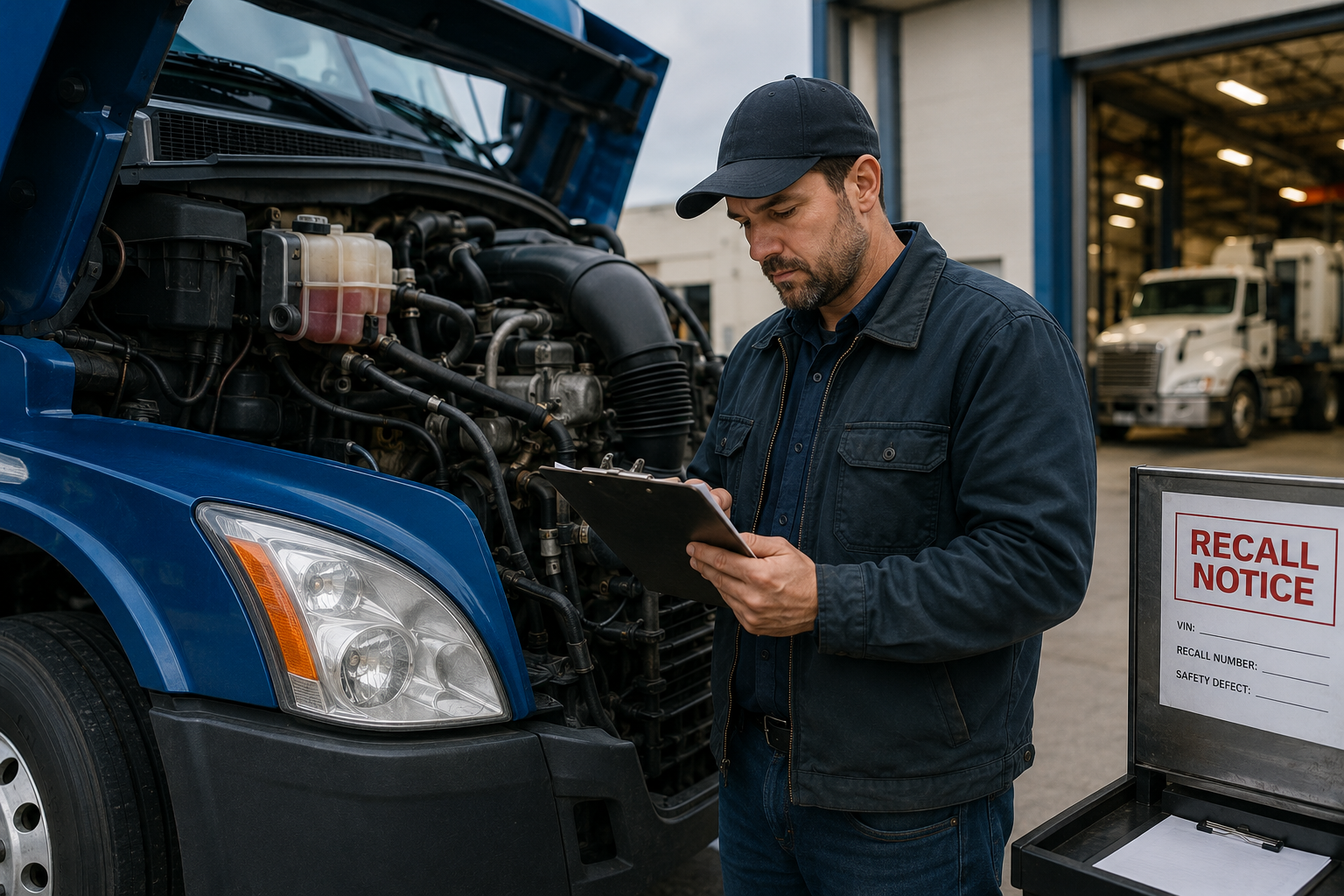

- A recall doesn't automatically mean your truck is unsafe.
Many recalls are preventative and affect an entire production run rather than a specific truck that has already failed. Understanding the difference can prevent unnecessary worry. - Most recall repairs are free.
Unlike normal maintenance, recall work is generally paid for by the manufacturer, including both parts and labor, although very old trucks may have different rules. - A recall is different from normal wear and tear.
Replacing a clutch, turbocharger, or leaking seal is routine maintenance. A recall corrects a defect that shouldn't have existed in the first place. - Technical Service Bulletins aren't recalls.
A TSB alerts technicians to common issues, but it usually isn't a free repair unless the truck remains under warranty. - You can usually sell a truck with an open recall.
In most situations, owner-operators can legally sell a used commercial truck with an open recall as long as they accurately represent its condition. - An open recall doesn't automatically reduce your truck's value.
Mileage, maintenance records, engine condition, and overall wear usually have a much greater impact on value than an unresolved recall. - Downtime can cost more than the repair itself.
Even when the repair is free, weeks or months waiting for backordered parts can cost thousands in lost revenue for a working truck. - Professional truck buyers expect recalls.
Experienced commercial truck buyers evaluate the entire truck, not just a single recall notice, making recalls much less of a dealbreaker than many owners assume. - Checking for recalls only takes a few minutes.
Using your truck's VIN through the NHTSA database or the manufacturer's website quickly shows whether any safety recalls remain open. - Sometimes a recall is simply the tipping point.
When an older truck already needs frequent repairs, an open recall and long parts delay may be the moment that makes selling the smarter business decision.
How to Decide Whether to Repair or Sell Your Semi-Truck
If you run a truck for a living, a recall notice in the mail can bring up a lot of questions fast. Some are practical. Can I still drive it? Is the fix free? How long will my truck be down? Others are financial. Does this hurt what my truck is worth, and is it one more sign it is time to move on?
Those are fair questions, and the answers are not always obvious. A recall is not the same thing as a breakdown, and it does not automatically mean your Semi-Truck is worth less. But depending on the truck, the mileage, and everything else going on under the hood, a recall can factor into a bigger decision about whether to keep pouring money into a rig or let it go.
At Kelly Truck Buyers, we talk with owner-operators and small fleet owners every day who are weighing exactly this kind of call. We buy commercial trucks in all sorts of conditions, including trucks with open recalls, so we see how these decisions play out in the real world. This article walks you through your options in plain terms. We are not here to talk you into selling. Sometimes the smartest move is to fix the recall and keep driving. The goal is just to help you understand what a recall actually means so you can make the right choice for your business.
What Is a Semi Truck Recall?
A recall happens when a manufacturer or a federal safety regulator decides that a vehicle has a safety defect or does not meet a federal safety standard. The National Highway Traffic Safety Administration, or NHTSA, oversees the process. Once a defect is confirmed, the manufacturer has to notify owners and offer a remedy.
Recalls cover a wide range of problems. Some are serious safety issues like brakes, steering, fuel systems, or anything that could cause a fire or a loss of control. Others are more preventive, meant to catch a problem before it ever affects the truck on the road.
A recall usually does not apply to just one truck. It covers every unit built with the same defect, often grouped by model year and build dates. So, a notice doesn't necessarily mean something is wrong with your specific rig right now. It means your truck belongs to a group that could be affected.
How Is a Recall Different from a Normal Repair?
A normal repair is something you pay for. A worn clutch, a failing turbo, a leaking seal, those are maintenance and wear items that come with the miles. You take it to a shop, you get a bill, and you cover it.
A recall is different. It addresses a defect the manufacturer is responsible for, and the fix is handled through the manufacturer rather than out of your pocket. A recall is about a flaw that should not have been there in the first place, not the normal aging of a working truck.
What About a Technical Service Bulletin?
You may also run into a technical service bulletin (TSB). This is not the same as a recall. A TSB is guidance from the manufacturer about a known issue that is not a safety defect. It might cover a performance quirk, an odd noise, or a repair procedure that helps technicians fix a common complaint.
The key difference is cost. A safety recall repair is provided at no charge under federal rules. A TSB is not automatically free, and the work is often covered only if your truck is still under warranty. Knowing which one you have matters, because it changes who pays.
Is It Legal to Sell a Semi Truck with an Open Recall?
For private owners and most used-vehicle sales, yes. No federal law stops you from selling a used truck with an open recall. The federal rule that bars sales with unrepaired recalls applies to new vehicles, not used ones.
That said, the rules can vary depending on who is selling and where. A few states have their own disclosure requirements, and California and Virginia are examples where used-vehicle recall disclosure applies. The Federal Trade Commission has also made clear that a seller cannot falsely advertise a recalled vehicle as fully safe or as having passed a rigorous inspection when a safety recall has not been fixed.
For an individual owner-operator selling a truck, the honesty piece is really the heart of it. You are not required to complete a recall before selling in most cases, but you should not misrepresent the truck's condition. Being upfront about an open recall is both the safe move and the right one.
It also helps to know that a recall generally stays with the truck, not the owner. Most safety recalls do not expire, and the open recall follows the vehicle until the work is done, even after it changes hands. A buyer can usually still get it addressed later.
Does an Open Recall Lower My Truck's Value?
Not by itself. An open recall does not automatically reduce your truck's value by a set amount. What determines value is the whole picture: mileage, engine condition, maintenance history, tires, overall wear, and how well the truck has been cared for.
A well-maintained Semi Truck with a strong service record and an open recall is still well-maintained. The recall is one line item, not a verdict on the entire rig.
Where a recall can affect value is more indirect. If the truck cannot be driven until it is repaired, that lost time has a cost. And if the recall is one of several issues stacking up on an older, higher-mileage truck, it adds to the sense that the rig is reaching the end of its useful life for you. In that case, the recall does not, on its own, lower the value. It is part of a larger condition story buyers already weigh.
Should I Repair the Recall Before I Sell?
This depends on your situation, and there is no single right answer.
If the repair is quick, the parts are available, and the fix is free, getting it done before you sell is often the simplest path. It clears the record, gives a buyer one less thing to think about, and keeps the truck ready to work.
But repairing first does not always make sense. If the parts are backordered for weeks or months, or if the truck is already sitting because of other problems, waiting on a recall fix just to sell can cost more in downtime than it gains you. Since the recall usually follows the truck to the next owner anyway, a buyer can often handle it after the sale. The real question is whether the repair is worth the wait for your business.
Are Recall Repairs Always Free?
Most of the time, yes. Under the National Traffic and Motor Vehicle Safety Act, the manufacturer has to provide a remedy at no cost to the owner. That remedy can be a repair, a replacement part, or in some cases a refund, and it covers the parts and the labor to fix the defect.
There is an important limit, though. The free-repair requirement does not apply forever. If a recall is filed more than 15 years after the vehicle was first sold, the manufacturer is no longer required to cover the fix for free. For an older Semi-Truck, that can matter, so it is worth checking the timeline.
It is also worth remembering that free does not mean cost-free to your business. The repair may not carry a bill, but the time the truck spends off the road still does. For an owner-operator, downtime is lost revenue, and that is a real cost even when the wrench work is covered.
One practical note: recall repairs generally have to be done at an authorized dealer, not an independent shop. Dealers have the manufacturer systems and reporting tools needed to complete the recall and record it properly. An independent mechanic cannot close out a recall in the official system, even if they do good work.
What If the Repair Parts Are Not Available?
This is a real problem, and more common than owners expect. Recall parts can go on backorder for weeks or even months. There have been recalls in which owners waited 3 to 4 months for a single part to arrive.
When parts are unavailable, you are stuck. The recall stays open because the fix cannot be completed, and the truck may or may not be safe to drive in the meantime, depending on the defect. For a working truck, a long parts delay can mean high lost income.
If your truck is still drivable and the recall is not an urgent safety issue, you can often keep running while you wait. For more serious recalls, the manufacturer may offer assistance while parts are on the way, so ask your dealer directly about the timeline and available support.
But here is where the math turns for some owners. If a recall part is going to keep your rig parked for months, and the truck already has age and mileage working against it, that delay can become one more reason to consider selling rather than waiting. A truck that cannot earn costs you every day it sits.
Will a Truck Buyer Still Purchase a Truck with an Open Recall?
Yes, many will, including us. An open recall does not make a truck unsellable. Professional buyers who work with commercial trucks understand that recalls are a normal part of ownership and consider the whole truck. The engine, mileage, maintenance records, tires, and overall wear tell them far more than a single open recall does.
At Kelly Truck Buyers, we buy trucks in a wide range of conditions, and an open recall is not a dealbreaker for us. We deal with these situations regularly, so we can talk through what your specific truck is worth without treating a recall like a red flag it is not.
How Do I Check My Semi Truck for Open Recalls?
The most reliable way is to use the VIN lookup tool on the NHTSA website. Your Vehicle Identification Number is a 17-character code and can usually be found on the truck, door jamb, or your registration paperwork.
Enter the VIN at the NHTSA recalls page and it will show any open safety recalls tied to that specific truck, along with what the defect is. You can also check the manufacturer's website, since they keep their own recall databases.
One thing to keep in mind: after a recall is repaired, it can take several weeks for the record to update in the government database. If yours still shows open right after the work, that lag is likely why. Keep your repair paperwork as proof the fix was done.
When Does a Recall Become a Reason to Sell Instead of Repair?
For a lot of trucks, a recall is a minor event. The fix is free, the parts are on hand, and the truck is back to work in a day. In that case, there is no real decision to make. You get it done and keep driving.
The picture changes when the recall lands on a truck that is already testing your patience. Maybe the miles are high. Maybe you have been putting more money into repairs than you would like. Maybe the parts are backordered and the truck is going to sit. When a recall stacks on top of everything else, it can tip a decision you were already circling.
At that point, the honest question is not really about the recall. It is about whether this truck still makes sense for your operation. If you are already spending too much time and money keeping it running, a recall with a long parts delay can be the nudge that makes selling the smarter move. If the truck is otherwise solid, the recall is just a quick errand.
Making the Call That Is Right for Your Business
A recall by itself is rarely the whole story. It is one factor among many, and often a small one. What matters is the full picture: the truck's condition, mileage, history, and how it fits your business going forward. Sometimes fixing the recall and staying on the road is clearly the best move. Other times, when the recall is one more line on a growing list, selling makes better sense.
If you are still deciding whether to repair your truck or move on, there is nothing wrong with getting another opinion. The team at Kelly Truck Buyers is happy to have a straightforward conversation about your truck, whether you are ready to sell today, in six months, or after you have completed the repairs. You can reach us at 800-790-1686 or through kellycarbuyer.com/contact-us.html. Our goal is simply to help you make the decision that is best for your business.