








What Should You Do When Your Semi Breaks Down in the Chicago Freight Corridor?
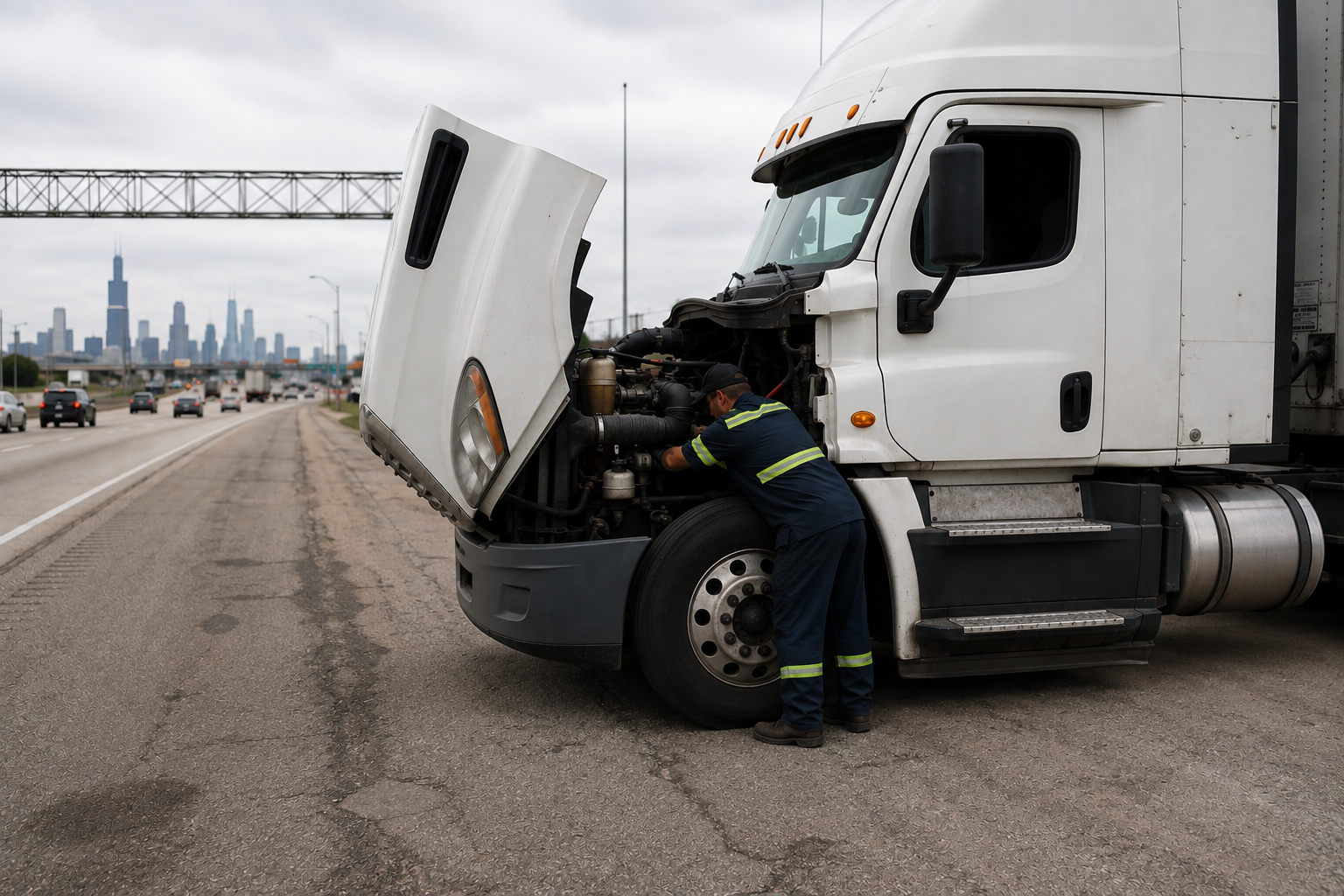
When a semi-truck breaks down in the Chicago freight corridor, the repair bill isn't the only cost to consider. Downtime, towing, lost loads, and long-distance repairs can quickly change the smartest financial decision. Kelly Truck Buyers, based just off I-80 in Frankfort, Illinois, works with truck owners nationwide and understands the realities of breakdowns around Joliet, Northwest Indiana, and one of America's busiest freight hubs. This guide explains what to do first, when repairing makes sense, when selling may be the better option, and how to evaluate the true cost of getting a truck back on the road.

8 Things Every Owner-Operator Should Do Before Approving a Major Semi-Truck Repair
- Get a written diagnosis first.
Never make a five-figure decision based on an estimate over the phone. - Calculate total downtime... not just repair costs.
Lost revenue, hotels, missed loads, and storage often exceed the repair invoice. - Consider where the truck is located.
A breakdown hundreds of miles from home changes the economics of every option. - Price the tow before committing.
Long-distance heavy-duty towing can completely change whether a repair still makes financial sense. - Evaluate the truck's remaining value.
A major engine failure doesn't automatically make a truck worthless. - Think beyond today's repair.
One expensive repair may be followed by several more on a high-mileage truck. - Compare repairing versus selling using real numbers.
Put repair costs, towing, downtime, resale value, and expected remaining service life on the same sheet before deciding. - Don't rush because you're stranded.
The first few hours are for gathering information... not making permanent financial decisions.
When Does Repairing a Semi Become More Expensive Than Replacing It?
If you run trucks long enough, sooner or later one of them stops running somewhere it wasn't supposed to. A check-engine light on I-80. A dropped valve outside Joliet. An after-treatment failure that strands a loaded truck at a shop near Gary while the clock runs on your delivery window.
When it happens far from your own yard and your own mechanic, the decision gets harder. You're weighing a repair estimate you didn't plan for, a truck that isn't earning, and a lot of unknowns about the shop that's holding it.
Kelly Truck Buyers is based in Frankfort, Illinois, right off I-80, in the middle of one of the busiest freight corridors in the country. We buy semi-trucks nationally, not just here, and we regularly use towing and transportation to purchase trucks wherever they sit. But this stretch of the Midwest is our backyard. We know what it looks like when a working truck becomes a stranded truck somewhere between Chicago and Northwest Indiana, and we know the math an owner has to run when that happens.
This article is about that specific situation: your truck is down, you're not home, and you're staring at a number that makes you wonder whether recovering the truck is even worth it.
Why do so many semi trucks break down around Chicago and I-80?
Part of it is simple volume. If enough trucks pass through one place, a lot of breakdowns are going to happen in that place too.
And an enormous number of semis pass through here. I-80 through Joliet and Will County carries roughly 80,000 vehicles a day, and about a quarter of that is truck traffic, according to the Illinois Department of Transportation. Local reporting puts the number of trucks moving through Joliet at around 20,000 on a typical day.
The freight itself is worth staggering amounts. Will County economic development figures put the value of freight passing through the county at well over $600 billion a year. The CenterPoint Intermodal Center in Joliet and Elwood is the largest inland port in North America, where containers move between rail and truck by the million.
Then there's rail. Roughly 25 percent of all U.S. rail traffic touches Chicago, and the metro area handles close to half of the nation's intermodal rail containers, according to the Chicago Metropolitan Agency for Planning. Chicago is the main interchange point between the eastern and western rail networks. Where the containers come off the trains, the trucks pick them up.
Add it up and you have I-80, I-55, I-57, I-94, I-90, I-355, and I-294 all funneling trucks through a single region, plus one of the densest clusters of warehouses and intermodal yards in the world.
Here's the part that matters for a breakdown. Many of the trucks rolling through here aren't fresh off the lot at the start of a short run. They've already got hundreds or thousands of miles on the current trip and hundreds of thousands on the odometer overall. A high-mileage semi sleeper that's been running hard is exactly the kind of truck that finally lets go, and this corridor is exactly the kind of place it's likely to be when it does.
What should you do first when your truck goes down away from home?
Safety comes before economics.
- Get the truck as far off the roadway as you safely can, get your markers out, and get yourself clear of live traffic. On a corridor this busy, with construction zones tied to the ongoing $1.3 billion I-80 rebuild, a disabled truck on a shoulder is a genuine hazard. Don't try to nurse it somewhere it doesn't want to go.
- From there, the order of operations is straightforward. Call roadside assistance or a tow, get the truck to a shop that can actually look at it, and get a real diagnosis. Not a guess over the phone. A real one.
- Then get the estimate in writing before you commit to anything major. You want to know what's actually wrong, what the parts and labor will run, and how long the shop expects the truck to be down. Those three numbers, the repair cost, the parts availability, and the downtime, are what every decision after this depends on.
Resist the urge to make the big financial call in the first hour on the shoulder. You don't have enough information yet, and decisions made under that kind of pressure tend to be expensive ones.
Should you repair a semi truck at a shop far from home?
Sometimes yes. Sometimes the smartest move is to fix it and keep rolling. But a repair away from home isn't the same as a repair at your own shop, and it's worth being honest about the differences.
You don't know this shop. You don't know their labor rate, their turnaround, or whether they'll stand behind the work. Parts for your engine or transmission may or may not be sitting on a shelf nearby, and a back-ordered component can turn a two-day job into a two-week one.
While that plays out, you're likely paying for a hotel, meals, and time you'd rather spend earning. If you had a load on, you may have already lost it. And even after the repair, you have to ask whether the truck goes back into dependable service or whether you'll be doing this again in a month.
None of that means you shouldn't repair it. A good shop, common parts, and a clear fix on an otherwise solid truck can make repair the obvious choice. It just means the sticker price on the estimate is only one input.
How much is downtime really costing you?
The repair invoice is the number everyone looks at. It's usually not the biggest number.
A truck sitting at a shop isn't generating revenue. For an owner-operator, that's your income parked in a bay. For a small fleet, it may mean a load reassigned, a customer covered late, or a driver sitting idle.
Stack up everything the breakdown actually costs. There's the tow. There's storage if the truck sits at a yard. There's lodging and travel for you or your driver. There's the load you couldn't deliver and the loads you can't book while the truck is down. And there's the cost of covering that capacity some other way, whether that's a rental, a hired truck, or leaning on the rest of the fleet.
Industry cost data has consistently shown that keeping a truck productive is where the money is, and every day of downtime works against you. You don't need a precise figure to feel it. If you know roughly what that truck nets you on a good week, you already have a sense of what each idle day is quietly costing.
The point isn't to scare you into a quick decision. It's the opposite. It's to make sure that when you compare repair against other options, you're comparing the full cost of the repair, not just the shop's number.
Is it worth towing a broken semi truck hundreds of miles home?
This is the one a lot of owners get wrong, and it's worth slowing down on.
The instinct is understandable. You want the truck back at your own yard, in front of your own mechanic, on ground you control. If the truck broke down two or three hours from home, that instinct is often right, and a tow home can be the sensible call.
But a long-distance heavy-duty tow is expensive, and the farther the truck is from home, the more that cost reshapes the whole decision. Hauling a disabled tractor several hundred miles can run into thousands of dollars before a single wrench turns on the actual repair. Add that tow to a repair estimate that was already large, and a truck that seemed borderline can tip firmly into "not worth it" territory.
Towing it home tends to make sense when the truck is close, when the repair is genuinely worth doing, and when your own shop can do it faster or cheaper than the one holding it. It makes a lot less sense when the truck is far away, the repair is heavy, and you'd be paying to transport a truck home only to then decide it isn't worth fixing.
Before you book a long tow home, it's worth asking a separate question first.
Can you sell a semi truck where it broke down?
Yes, often you can. And a lot of owners don't realize it.
A truck doesn't have to be repaired, running, and driven back to your yard before it can be sold. Depending on the buyer, the truck's condition, the title situation, and the location, it's frequently possible to evaluate and purchase a disabled truck right where it sits, with transportation handled afterward.
That's a big part of how Kelly Truck Buyers works. We buy trucks nationally, and we routinely arrange towing and transportation rather than asking a seller to bring the truck to us. You don't have to get a dead truck running just to sell it, and you don't have to haul it across three states first.
Practically, that means the tow-it-home question and the sell-it question can be answered together. If the truck may be worth more sold than repaired, paying to drag it home first can be money spent solving the wrong problem.
Does a broken-down sleeper truck still have value?
A major failure doesn't automatically make a truck worthless. Owners are often surprised by that.
What a disabled truck is worth depends on a lot more than the thing that just broke. Year, make, and model matter. So do the engine and transmission, the mileage, the sleeper configuration, and the overall condition of the truck. Maintenance history matters. Tires matter. Body and frame condition matter. And current market demand for that particular kind of truck matters a great deal.
The nature of the failure is one factor among many, not the whole story. A blown engine on a truck that's otherwise straight, with a good transmission, decent rubber, and a clean frame, can still carry real value. The mechanical problem lowers the number. It rarely zeroes it out.
This is why it's worth getting a truck evaluated as it sits rather than assuming the repair estimate defines what the truck is worth. Those are two different questions.
When does another repair stop making financial sense?
There's no magic percentage and no mileage line where every owner should sell. Anyone who tells you "sell at 40 percent of value" or "sell at a million miles" is selling you a rule of thumb, not real advice.
What you actually want is a comparison. On one side, put the full cost of getting this truck back on the road: the repair, the tow, and the downtime. Then be honest about what's coming next. A truck with one big failure often has a few smaller ones lining up behind it.
On the other side, put what the truck is realistically worth after the repair, how much dependable life you expect to get out of it, and your own ability to replace it or operate without it for a while.
When the cost of the repair plus the tow plus the downtime starts approaching what the truck will be worth once it's fixed, and especially when you don't trust it to stay fixed, that's when another repair stops making sense. When the repair is modest, the truck is otherwise solid, and you expect real service life out of it, fixing it is the smart move. Kelly doesn't need to win that decision. Sometimes repair genuinely is the right answer.
What if you own a small fleet and one truck goes down?
If you run a handful of trucks, the math has an extra dimension.
For a single owner-operator, a down truck is lost income. For a fleet owner with 3, 6, 10, or 20 trucks, one unreliable truck can pull on the whole operation. It complicates dispatching. It eats maintenance hours that other trucks need. It puts drivers in equipment they don't trust, or leaves a good driver sitting.
One problem truck can quietly cost you more than its own repair bills by dragging attention and resources away from the rest of the fleet. There's a point where continuing to nurse it along is more disruptive than simply replacing it.
Selling or retiring one troublesome truck and redeploying that capital or that capacity is sometimes the cleaner decision for a fleet, even when the same repair might be worth doing on a single-truck operation. The right call depends on how that specific truck fits, or doesn't fit, into keeping your whole operation dependable.
What should you know if you break down around Chicago, Joliet, or Northwest Indiana?
Breaking down in a major freight hub cuts both ways.
The good side is real. This corridor has heavy-duty shops, towing outfits, dealers, and parts availability that a lot of the country doesn't. If a component has to be found fast, your odds are better here than on a rural stretch of interstate somewhere. There are plenty of people who work on trucks like yours every day.
The hard side is just as real. This is a congested region, and it's getting more so as the warehouse and intermodal footprint keeps growing around Joliet and Will County. Ongoing construction on I-80 adds to it. Labor here isn't cheap. Storage on a truck that sits adds up. And every day tangled in traffic, tows, and shop scheduling is another day the truck isn't earning.
So a breakdown here gives you more options and more pressure at the same time. More ways to get the truck fixed, and more cost pushing you to make a decision quickly.
While we buy in Texas, Georgia, and around the country, that's the corridor Kelly Truck Buyers operates in every day. We're in Frankfort, just off I-80, a short distance from the intermodal yards, the warehouse districts, and the interstates that feed them. That's not the only place we buy trucks. But it does mean that when an owner calls about a truck sitting near Joliet, Gary, or anywhere along these routes, we have a ton of personal and local experience understanding the area the situation they're actually in.
If your truck is down and the estimate has you second-guessing
If your truck is sitting at a shop, a tow yard, a terminal, or a roadside repair facility, and you're looking at a repair number that makes you question whether you want to put more money into it, you don't have to make that call blind.
Tell Kelly Truck Buyers what you've got. The truck, where it is, what's wrong with it, and what you've been told the repair will cost. We can make an offer based on the truck as it sits. Because we buy trucks nationally and work with towing and transportation, it doesn't have to be driven or hauled back to Frankfort first.
Then you can put that offer next to the repair, the tow, and the downtime, and decide which one actually makes sense for you. Maybe that's selling. Maybe it's fixing the truck and getting back to work. Either way, you're deciding with real numbers in front of you instead of guessing.
You can reach Kelly Truck Buyers online or at 800-790-1686. No hard closes. Just a family run business with two generations of experience.