









Should I Rebuild My Semi Truck Engine or Replace the Truck?
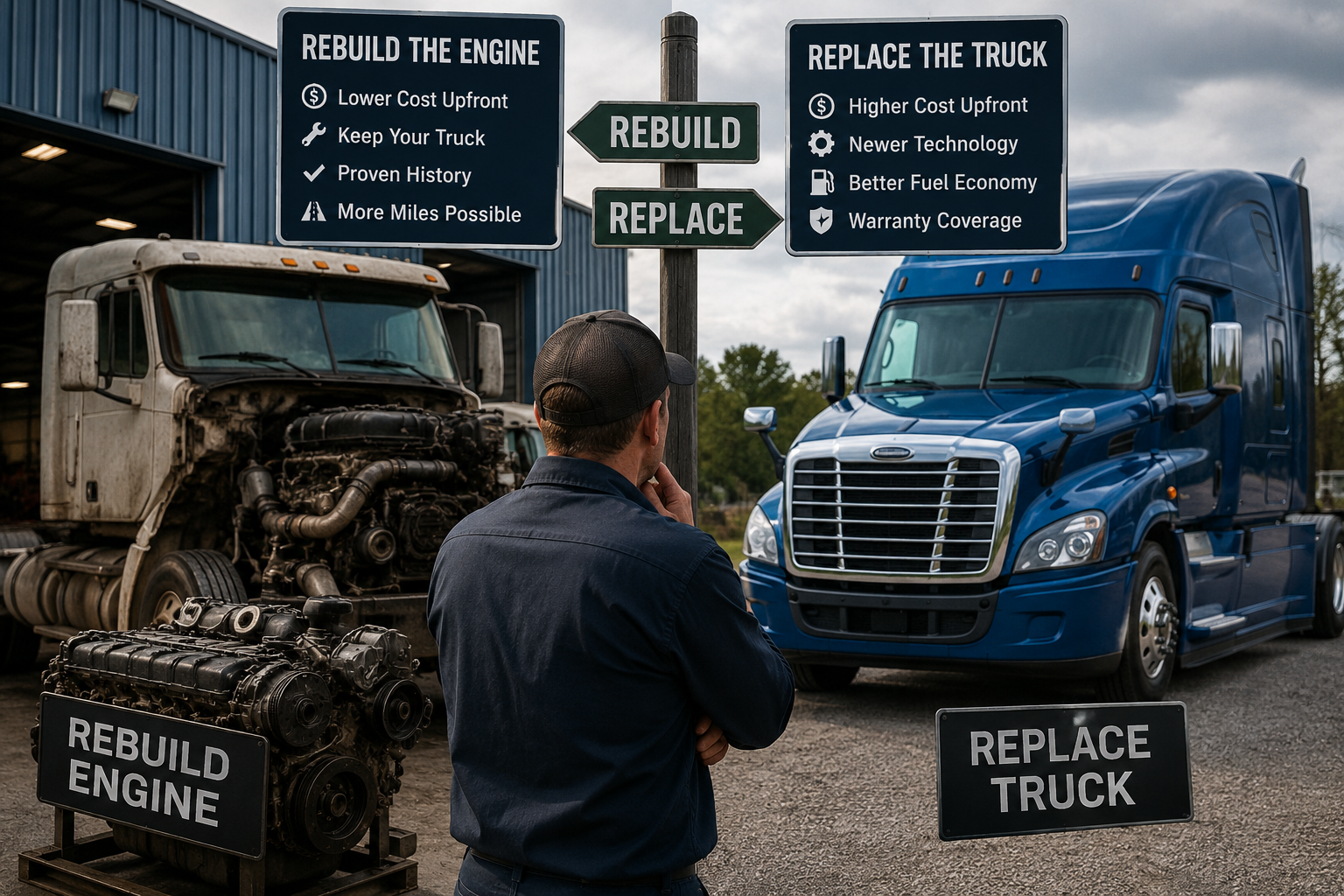
Should you rebuild your semi-truck engine or replace the truck? The right answer depends on more than the repair estimate. Mileage, maintenance history, drivetrain condition, emissions problems, downtime, and the truck’s value after the repair all matter. A quality rebuild can add hundreds of thousands of miles, but it may not make financial sense if other major systems are also failing. Comparing every option, including selling the truck as-is, can help you make the decision with real numbers.

8 Questions to Answer Before Rebuilding a Semi-Truck Engine
- What type of engine repair does the truck actually need?
An in-frame rebuild, out-of-frame overhaul, and replacement engine involve very different costs, timelines, and expected results. - How much will the complete repair really cost?
The original estimate may not include additional problems discovered after the engine is opened, such as damaged injectors, turbochargers, cooling components, or internal parts. - How much revenue will you lose during the downtime?
A truck that spends several weeks in the shop is not producing income. Lost revenue can make the true cost considerably higher than the repair invoice. - How many productive miles could the rebuild add?
A properly completed rebuild may provide another 400,000 to 600,000 miles, but only if the rest of the truck remains dependable. - What condition are the transmission and drivetrain in?
A healthy rebuilt engine does not protect you from an aging clutch, transmission, rear ends, suspension, or other expensive components. - Are emissions-system repairs likely to come next?
DPF, SCR, EGR, and other aftertreatment problems can add thousands of dollars in repairs after the engine work is completed. - How much will the rebuild add to the truck’s resale value?
A documented rebuild can improve value and make the truck easier to sell, but owners rarely recover the entire repair cost through a higher sale price. - What is the truck worth right now in its current condition?
Getting an as-is offer gives you a real number to compare against rebuilding the engine, installing a replacement engine, or purchasing another truck.
Is It Worth Rebuilding a Semi-Truck Engine? Costs, Mileage and Resale Value
When a semi-truck engine fails, the repair estimate is only half the story. The bigger question is whether that money belongs in this truck at all, or whether you are about to pour a rebuild into a chassis that is closer to the end of its working life than the odometer suggests.
This is one of the hardest calls an owner-operator or small fleet owner has to make. A semi truck engine rebuild can cost as much as a decent used truck, and the wrong decision either strands you with a fragile rig or throws away a truck that had years left in it.
Kelly Truck Buyers has spent more than a decade evaluating and buying used semi-trucks across the lower 48, including plenty with mechanical problems, blown engines, and failed aftertreatment systems. That gives us a clear view of what these trucks are actually worth before and after a major repair.
This article is meant to help you think the decision through honestly, not to push you toward selling. Sometimes rebuilding a good truck is exactly right. Other times the engine failure is the moment to stop spending.
First, Figure Out Which Repair You Are Actually Being Quoted
"Rebuild" gets used loosely. Before you compare any numbers, get clear on which of these four paths a shop is quoting, because they cost very different amounts and buy you very different results.
In-frame rebuild (in-frame overhaul)
An in-frame overhaul leaves the engine block in the truck. The shop pulls the head and oil pan and replaces the wear parts: liners, pistons, rings, rod and main bearings, gaskets, and usually a head service.
It is the most common major engine repair because it skips the labor of removing the whole engine. It works when the block, crankshaft, and cam are still healthy and the damage is limited to normal wear.
Out-of-frame overhaul
An out-of-frame rebuild removes the engine entirely so the block and head can be inspected, machined, bored, and pressure-tested. It restores the engine closer to factory tolerances.
It costs more and keeps the truck down longer, but it is the right call when there is deeper damage, very high mileage, or a failure that sent debris through the engine.
Remanufactured or replacement engine
Instead of rebuilding your engine, you install another one. That can be a used running takeout, a reman long block, or a full remanufactured or crate engine.
A semi truck engine replacement usually gets you back on the road faster because the engine is ready to drop in, and a reman or crate unit comes with a real warranty. The tradeoffs are a higher parts cost and matching the right configuration to your truck.
Replacing the truck
The fourth option is not an engine repair at all. You keep your capital out of an aging chassis and put it toward a newer truck, or you sell the current one and let someone else deal with the engine.
Which path fits depends less on the engine than on everything attached to it. We will get there.
How Much Does It Cost to Rebuild a Semi Truck Engine?
There is no single price, and any shop that gives you a firm number before diagnostics is guessing. What is realistic in 2026 are planning ranges.
For most heavy-duty Class 8 diesels, an in-frame overhaul runs roughly $15,000 to $25,000, and an out-of-frame rebuild runs roughly $25,000 to $40,000 or more. A lighter top-end job, if that is all the engine needs, can land closer to $8,000 to $15,000.
Labor drives a large share of that. A proper rebuild takes a certified diesel tech 40 to 60 hours, and labor often makes up 60 to 70 percent of the bill at shop rates commonly in the $120 to $180 per hour range.
Two things push the final number past the estimate: what the shop finds once the engine is open, and everything around the engine that fails at the same time, such as a turbo, injectors, or cooling parts. Semi-truck repair costs on a high-mileage engine rarely stay inside the original quote.
A diesel engine rebuild cost also has to account for downtime. An out-of-frame job can keep the truck down one to three weeks, and for many owner-operators the lost revenue rivals the invoice.
How Long Should a Rebuilt Diesel Engine Last?
This is the number that makes a rebuild worth it. A properly done rebuild, with quality parts, correct machining, and a disciplined break-in, commonly returns 400,000 to 600,000 miles of service, and a strong one can go further.
For context, a well-maintained modern heavy-duty diesel such as a Detroit DD15, Cummins X15, PACCAR MX-13, or Volvo D13 often reaches 750,000 to 1,000,000 miles or more before it needs that first major overhaul.
So a good rebuild does not make the engine new, but it can realistically buy several more years of work. The catch is that those miles only pay off if the rest of the truck lasts as long as the engine does.
Is an In-Frame Rebuild Worth It, and What Should You Weigh Beyond the Estimate?
An in-frame rebuild is usually worth it when the block is sound, the truck has real life left, and you have a shop you trust. It restores the expensive part of the truck for less than replacing it. It is not worth it when a low quote is hiding a deeper problem, or when the engine is only one of several systems about to cost you money.
So before you approve any rebuild, look past the engine at the whole truck.
- Mileage and age. A rebuild on a 600,000-mile truck with a clean history is a different bet than the same rebuild on a 1.2-million-mile truck.
- Maintenance history. Documented oil changes and service records suggest the block was cared for. Gaps suggest you may be fixing symptoms.
- Transmission and drivetrain. If the transmission, clutch, or rear ends are also worn, the engine repair only delays the next big bill.
- Emissions and aftertreatment. This is the one that surprises owners. A full aftertreatment replacement can run $8,000 to $15,000 on its own, a turbo another $3,000 to $6,000, and these problems get more frequent past the 300,000 to 450,000-mile mark. A fresh engine behind a failing DPF or SCR system is not a finished truck.
- Frame, rust, and cab condition. Corrosion and a tired cab do not fix themselves, and they cap what the truck can ever be worth.
- Financing and cash flow. Paying cash for a rebuild is very different from financing one on a truck you still owe money on.
Likelihood of the next major repair. Be honest about what breaks next, and when.
Does Rebuilding the Engine Increase the Truck's Resale Value?
Yes, but usually not dollar for dollar. A documented fresh rebuild, or a reman engine with remaining warranty, is a genuine selling point, and it does raise what a buyer will pay.
What it rarely does is return the full cost. Spending $30,000 on a rebuild does not add $30,000 to a truck that was worth $25,000 before the engine failed. The rebuild removes a buyer's biggest fear, which helps the truck sell and supports a higher price, but the market pays for the whole truck, not just the newest part on it.
If your main reason for rebuilding is to sell afterward, run those numbers carefully. The gain in sale price is often smaller than the repair bill.
When Is a Semi Too Old or Too High-Mileage to Justify a Rebuild?
There is no single odometer cutoff, because a well-kept million-mile truck can be a better rebuild candidate than a neglected 700,000-mile one. The better test is whether the truck has three or more years of reliable revenue left in it after the repair.
A rebuild gets hard to justify when several of the warning signs above stack up at once: high mileage with a thin service record, a worn transmission or rear ends, a failing or already-patched aftertreatment system, frame or cab corrosion, and a repair you would have to finance on top of what you still owe.
When the engine is just the first domino, putting another large sum into the truck usually means paying to keep an aging asset alive a little longer, not buying years of clean operation.
How the Math Changes Among Truck Makes and Engines
The decision is not identical across brands, but the difference is rarely a fixed price gap. What actually varies is parts availability, shop familiarity, how tightly the engine is tied to the truck, and how well the platform holds resale value.
Freightliner and Western Star with Detroit power. The Detroit DD15 and the older Series 60 are among the most common engines on the road, so parts and shops that know them are everywhere. That competition tends to keep rebuild pricing reasonable, and independent in-frame quotes on a DD15 often run lower than dealer out-of-frame work.
Peterbilt and Kenworth with PACCAR MX or Cummins. Many run the PACCAR MX-13, a solid engine that is often steered toward Kenworth and Peterbilt dealers for major work, where quotes can run higher than at an independent shop. Plenty were also ordered with Cummins power, which widens your options.
Cummins X15 and ISX15 in any chassis. Cummins has the broadest parts and service network of any heavy-duty engine, plus a strong remanufactured program and widely available used takeout engines. That usually means more shops competing for the work and a real reman-versus-rebuild choice.
Volvo and Mack with D13 or MP8. These engines are frequently part of an integrated powertrain and are often serviced within the Volvo and Mack network, which can narrow where you get the work done and affect the quote.
International with A26, Cummins, or older MaxxForce. Newer International trucks with the A26 or S13 integrated powertrain are a different animal from the MaxxForce era, which earned a rough reputation for aftertreatment and EGR trouble. Many buyers prize older International trucks built with Cummins power. That history affects both repair economics and resale.
One pattern cuts across all of them. Older pre-emissions engines such as the Series 60, N14, and CAT C15 or 3406 are often cheaper and simpler to rebuild, with no DPF or SCR to fail, which is why they stay popular rebuild candidates even when the trucks are old.
We will not invent brand-by-brand rebuild prices, because honest ones do not exist without diagnostics on your specific engine. Get at least two quotes for your exact engine and configuration.
So Should You Rebuild, Replace the Engine, Replace the Truck, or Sell As-Is?
Line the four options up against one number: what the truck will be worth, and how long it will run, after you spend the money.
- Rebuild when the block is sound, the rest of the truck is healthy, and the repair buys years, not months.
- Replace the engine with a reman or crate unit when you need to be back on the road fast and want warranty coverage, and the rest of the truck justifies it.
- Replace the truck when the engine is one of several major systems failing, or when a newer, more reliable truck costs less over time than a chain of repairs.
- Sell as-is when the repair cost approaches the truck's value, when multiple systems are done, or when the downtime and cash-flow hit are more than the truck is worth to you.
Notice that selling is a real option with a real number attached, not a last resort.
What Happens If You Cannot Afford to Rebuild Your Semi Truck Engine?
This is a common, stressful spot, with more moves than it feels like in the moment.
You can price a used running takeout engine or a reman long block, which can cost less than a full rebuild and get you running again. You can get a second and third quote, since rebuild estimates for the same engine vary widely by shop and region. Some shops and parts suppliers also offer financing on the repair itself.
But if the truck was already aging, financing a large repair on top of an existing loan can dig the hole deeper. A truck with a blown semi truck engine still has value, often more than owners expect, through its transmission, axles, drivetrain, cab, and salvageable components.
Kelly Truck Buyers purchases semi-trucks in virtually any condition, including trucks with blown or damaged engines, anywhere in the lower 48, and pays cash without asking you to tow it in. For some owners, the cash from selling as-is becomes the down payment on a better truck. That is not the right answer for everyone, but it is worth knowing the number.
Put a Real Number on the "Sell It As-Is" Option
The rebuild-versus-replace decision gets a lot clearer when you stop comparing the repair bill to your gut and start comparing it to actual figures.
You already have, or can quickly get, most of them: the rebuild or replacement quote, the truck's likely value after the repair, and the cost and downtime of each path.
The one number most owners are missing is what the truck is worth right now, as it sits, with the engine down.
Kelly Truck Buyers can give you that number quickly, with no obligation. Even if you decide to rebuild, having a real as-is offer in hand lets you make the call with all the figures on the table instead of guessing at one of them.
To get that number, call Kelly Truck Buyers at 800-790-1686 or use the online quote form at kellytruckbuyers.com/quote.html. Whatever you decide, you will be deciding with real numbers instead of hope.